


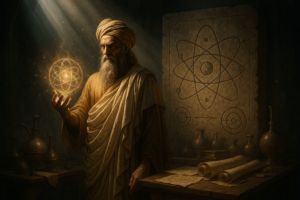
What is matter? It’s a question so fundamental, so deeply ingrained in our everyday experience, that we rarely pause to truly consider it. Yet, the answer forms the very fabric of our reality, the essence of everything we see, touch, and use. From the humble pen in your hand to the sturdy chair supporting you, anything that possesses mass and occupies space is, quite simply, matter. This profound understanding – that matter constitutes the essence of the universe – has echoed through human history, reaching back to the dawn of scientific thought.
Consider, for a moment, the device you’re using to read this. Does it “matter”? Absolutely. It possesses a definite mass, and it occupies a specific volume. So, yes, your device is matter—and so is every other tangible object in the physical world.
But this simple observation leads us down a more profound path: What, then, is matter made of? This enduring mystery has captivated thinkers for millennia. While modern science largely credits John Dalton with formalizing the atomic theory, the roots of this revolutionary idea stretch far deeper into the annals of ancient times, particularly within the rich philosophical traditions of India and Greece. Before Dalton, long before the sophisticated laboratories and instruments of today, brilliant minds grappled with the fundamental composition of existence. The quest to understand how matter was made, and what its ultimate, indivisible constituents might be, became a central dilemma. And it was in this intellectual cauldron that the idea of the atom was first conceived.
The Dawn of Atomic Thought in Ancient India: Acharya Kanada and the Parmanu
The credit for the earliest known atomic theory, formulated approximately 2,600 years before John Dalton, belongs to an extraordinary Indian sage and philosopher: Acharya Kanada. Born in Prabhas Kshetra (near Dwarka) in Gujarat, India, some historical accounts place him around the 6th century BCE, while others suggest the 2nd century BCE. Regardless of the precise date, his contributions were groundbreaking. Kanada founded the philosophical school of Vaisheshika and authored the foundational text, the Vaisheshika Sutra. These Sutras are a remarkable fusion of science, philosophy, and spiritual insight, with the atomic theory of matter standing as their most vital contribution.
Acharya Kanada’s given name was Kashyap, but his transformation from Kashyap to ‘Kanada’ is a captivating tale that beautifully illustrates his profound insights.
The story unfolds as Kashyap embarks on a pilgrimage to Prayag, now known as Allahabad. As he walked through the bustling streets of Prayag, his gaze fell upon the scattered offerings of flowers and rice left by other pilgrims around the temple. Unlike others, who saw only discarded remnants, Kashyap began meticulously collecting the tiny grains of rice strewn across the ground. A crowd soon gathered, their faces etched with curiosity and perhaps a touch of bewilderment. “Why are you picking up these seemingly worthless rice grains?” they inquired.
Kashyap’s reply was as simple as it was profound: “Individual rice particles, in themselves, may seem worthless. But a collection of hundreds of them makes a person’s meal. The aggregation of many meals can feed an entire family, and ultimately, nourish all of humankind.” He continued, “Thus, even a single grain of rice is as important as all the beneficial wealth in this world, for it is the fundamental building block of sustenance.” From that day forward, people began to call him ‘Kanada,’ derived from the Sanskrit word ‘Kan,’ meaning ‘the smallest particle.’
One day, the legend continues, Kanada was walking with a piece of food (matter) in his hands, systematically breaking it into smaller and smaller pieces. He continued this process until he reached a point where he realized he could not divide the food into any further parts. It was from this moment of profound observation that Kanada conceptualized the idea of a particle that could not be divided any further. He named this indivisible matter Parmanu or anu (atom).
Kanada’s theories were far-reaching. He classified all objects of creation into nine elements: five material and four non-material substances. The five materialistic substances were: Earth, Water, Fire, Air, and Akasha (ether). The four non-material substances were: space, time, soul, and mind. Our focus here is on the material substances. Kanada posited that Earth, Water, Fire, and Air were atomic and were associated with our senses of smell, taste, sight, and touch, respectively. Interestingly, he considered Akasha (ether) to be non-atomic, infinite, and related to sound waves, existing in a constant state of motion unlike the other elements.
He further theorized about the composition of living beings, drawing compelling analogies. For instance, he suggested that vegetables primarily consist of water, while insects incorporate water and fire. Birds, he believed, comprised water, fire, earth, and air. Humans, the most complex beings, were understood to embody all five elements, including ether. Kanada also proposed that just as fire, wind, and the mind exhibit natural movement, so too must atoms be in a constant state of motion.
Kanada’s atomic theory extended to the formation of molecules. He stated that every object in creation is made of atoms, which can combine with each other to form larger entities. He specifically posited that the combination of two atoms would form a diatomic molecule (dvyanuka), and three atoms would form a triatomic molecule (tryanuka). He also identified the existence of different types of atoms, asserting that each type possessed specific properties inherent to the class of substance it belonged to. For example, he would suggest that the atoms present in an apple would carry the inherent “properties of an apple.” Crucially, Kanada believed that atoms belonging to different classes of substances could also combine in various ratios. A striking example, though using modern terms, would be the combination of hydrogen and oxygen atoms to form a water molecule in a 2:1 ratio, or hydrogen peroxide in a 1:1 ratio, illustrating a concept akin to definite proportions.
Moreover, Kanada proposed that atoms combine in various ways to produce chemical changes, often in the presence of heat or fire. He identified fire or heat as a primary catalyst for such transformations. He provided relatable examples: water boiling, earthen pots blackening when fired, and fruits ripening – all processes demonstrably influenced by heat.
While his philosophy was based on logic and observation rather than modern experimental methods, a deeper dive into the Vaisheshika Sutra [1] reveals a theory remarkably advanced for its time, anticipating many concepts that would be rediscovered centuries later.
The Samkhya Philosophy and the Gunas
Beyond the Vaisheshika school, another profound Hindu philosophy, Samkhya (meaning ‘number’), also delved into the fundamental nature of particles responsible for the universe’s evolution. Propounded by Kapila Muni, the exact century of its origin remains a subject of academic debate.
Samkhya philosophers, while supportive of the existing atomic theories in India, were not entirely satisfied that mere atoms could be the ultimate cause of everything in the universe. Their core belief, “something can only come from something,” led them to infer that if matter is formed from atoms, then atoms themselves must have evolved from even subtler, more fundamental particles. To illustrate, they might argue that a table is formed from wood, which is derived from cellulose. Cellulose, in turn, is formed from cellulose molecules, which themselves are comprised of carbon, hydrogen, and oxygen atoms. The Samkhya thinkers pushed this chain of inquiry further: these atoms, they reasoned, must be an outcome of some yet more fundamental particles.
This philosophy introduces two ultimate realities: Prakriti and Purusha. Prakriti is understood as the primordial, unmanifest cause of all matter, the very source from which all physical existence emerges [1]. When Prakriti combines with Purusha, meaning “spirit” or “consciousness,” the grand evolution of the universe unfolds. Our focus here, however, remains on Prakriti, as it is the fundamental cause of all discernible objects around us. In a simplified sense, Prakriti can be related to the concept of atoms, where the combination of these foundational units leads to the formation of all matter.
Samkhya philosophy posits that Prakriti possesses three main constituents or gunas: sattva, rajas, and tamas.
- Sattva is associated with qualities like happiness, brightness, and lightness.
- Rajas is linked to activity, motion, and dynamism.
- Tamas is the constituent related to material mass, resistance to motion, and inertia.
Intriguingly, we can draw fascinating parallels between these ancient gunas and modern atomic theory.
- Rajas guna can be related to electrons. Electrons are constantly in motion within an atom and are responsible for an atom’s reactivity and interactions.
- Sattva guna can be linked to protons. Protons are positively charged, and sattva embodies positivity and illumination.
- Tamas guna can be seen as corresponding to the nucleus and neutrons. The nucleus accounts for nearly all of an atom’s mass, and neutrons, residing within the nucleus, are not directly involved in the atom’s chemical activity or motion. They represent the “mass” and “resistance to motion” within the atom’s core.
Therefore, one could argue that the Samkhya philosophy, with its profound understanding of underlying constituents and their properties, offers a conceptual framework remarkably close to the modern atomic theory’s description of subatomic particles.
The Greek Pursuit of the Indivisible: Democritus and Epicurus
Following the profound insights of Hindu thinkers, Greek philosophers also embarked on their own quest to understand the fundamental constituents of matter. In the 4th century BCE, figures like Parmenides, Leucippus, his renowned follower Democritus, and Epicurus put forth the idea that matter is homogeneous and composed of an infinite number of tiny, indivisible particles – which they also called atoms (from the Greek atomos, meaning ‘uncuttable’ or ‘indivisible’).
Leucippus, Democritus, and Epicurus further elaborated on this concept, positing that these atoms were in a constant state of motion, and therefore, there must be a void or empty space in which they could move. Imagine a bustling marketplace: if there’s no empty space, no pathways between the stalls, how can people move? Similarly, atoms, to be in perpetual motion and to combine and separate, required the existence of empty space. They believed that the collisions and regroupings of these atoms, perpetually moving within the void, formed the myriad compounds that constitute the world we experience.
Among these Greek atomic theorists, the story that has resonated most strongly through history is that of Democritus. The tale goes that he picked up a seashell and broke it in half. He then took one of those halves and broke it again, and again, continuing this process until he was left with a fine powder. He then attempted to divide the smallest particles within that powder, but found himself unable to do so. From this simple, yet powerful, observation, Democritus proposed that the ultimate, indivisible building block of matter – and indeed of all existence – was the atom.
Democritus believed that atomic motion was simply due to the inherent collisions between atoms. Epicurus, building upon Democritus’s ideas, introduced a subtle but significant refinement. He suggested that atoms, possessing some weight, naturally moved in a downward direction. However, to account for the collisions and interactions that lead to the formation of macroscopic objects, Epicurus introduced the concept of a “swerve” – a random, unpredictable sideways movement of atoms. This “swerve” allowed for collisions between atoms that were otherwise falling in parallel lines, a crucial addition not considered by Democritus.
Interestingly, Democritus held that properties like sweetness or color were not inherent “real” qualities of the atoms themselves. He believed that the same body could appear differently to different perceivers depending on how its constituent atoms interacted with our sense organs. For example, honey might taste bitter to an ill person, illustrating the subjective nature of perception. Epicurus, while agreeing that such properties didn’t exist at the individual atomic level (a single atom isn’t “sweet”), argued that these properties were indeed real at the macroscopic level. He contended that bodies experience properties like pain in the leg, the color of the sky, or the bitterness of coffee precisely because of their atomic structure and the emergent capabilities of their interactions, and that these capabilities were objectively real.
Epicurus also held a foundational belief that “nothing comes into existence from nothing,” leading him to conclude that the universe has no beginning and no end. It has always existed and will continue to exist forever. Consequently, atoms themselves were also thought to have always existed. Epicurus further argued that the universe must be unlimited in size. If it were finite, he reasoned, one could always go to its edge and find a new limit, implying an endless extension. Therefore, there must also be an unlimited number of atoms and an infinite amount of void.
The Reign of Aristotle and the Four Elements
However, the powerful influence of Aristotle later eclipsed the Greek atomic theories. Aristotle, a towering figure in Western philosophy, fundamentally disagreed with the atomic theory [2]. He believed that all matter on Earth was not made of indivisible atoms, but rather composed of various combinations of four fundamental elements: Earth, Fire, Water, and Air. He posited that all matter was simply small amounts of these four elements mixed in different proportions. Most people, captivated by Aristotle’s intellectual prowess and comprehensive philosophical system, adopted his view. This led to Democritus’s groundbreaking idea being largely overlooked and sidelined for approximately 2,000 years! Aristotle’s geocentric view of the cosmos and his elemental theory dominated Western thought for centuries, a testament to his immense intellectual authority. It wasn’t until much later, with the advent of the scientific revolution and the discovery of the periodic table, that his elemental teachings were definitively proven incorrect and departed from the modern view of the atom.
Another prominent philosopher, Plato, also embraced the idea of the four elements, adding a fifth: ether (which Aristotle also acknowledged as the material of the heavens). Plato famously derived these five elements from five regular solid shapes, known as the Platonic Solids: the cube (Earth), tetrahedron (Fire), octahedron (Air), icosahedron (Water), and dodecahedron (Ether). While Plato believed in the existence of fundamental, indivisible units, he linked them to these geometric forms, suggesting that atoms were derived from these five fundamental solids.
The Scientific Revival: John Dalton and the Modern Atomic Theory
These early ideas, both from India and Greece, were largely philosophical in nature. They were brilliant conceptualizations, born from keen observation and logical deduction, but they lacked a crucial component: the ability to be rigorously tested or to provide experimental evidence.
That changed dramatically in the 19th century with the work of John Dalton. He revived the atomic theory, but this time, his propositions were supported by quantifiable data and meticulous experiments, particularly in the realm of gases and chemical reactions. Dalton proposed that each chemical element is made of atoms of a single, distinct type, and that chemical reactions involve the rearrangement, combination, or separation of these indivisible atoms, rather than their creation or destruction. His work, including the Law of Multiple Proportions, provided concrete evidence for the existence of atoms and their role in chemical phenomena, ushering in the era of modern chemistry.
Though ancient thinkers lacked the sophisticated tools and methodologies of modern science, their profound insights laid the intellectual groundwork for centuries of scientific progress. Their stories serve as a powerful reminder that human curiosity about the fundamental nature of the universe is timeless—and that even the smallest “grain of thought” can, through generations of inquiry and refinement, grow into a world-changing idea. The journey from the scattered rice grains of Acharya Kanada to the subatomic particles of quantum mechanics is a testament to the enduring human quest to understand the very essence of matter.
References:
- Chatterjee, S.C., & Datta, D.M. (2016). An Introduction to Indian Philosophy. University of Calcutta.
- Lloyd, G.E.R. (1970). Early Greek Science: Thales to Aristotle. W. W. Norton & Company.