
Atomic Radius
How big is an atom, really?
Atomic radius is a measure of atomic size. There are three different ways in which atomic radius can be calculated: covalent radius, metallic radius, and Van der Waals radius. The atomic radius is typically calculated using the X-ray diffraction method.
Across a period, the nuclear charge increases while electrons fill the same shell — the cloud is pulled in tighter, so atomic radius decreases. Down a group, a new shell is added each time, so the radius grows substantially even though nuclear charge also climbs.
Three types are used depending on the bonding context:
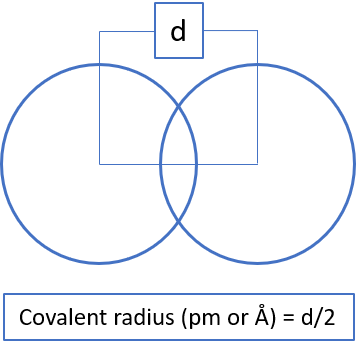
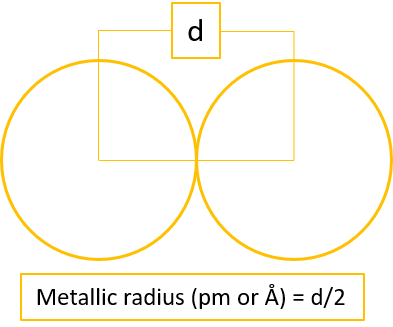
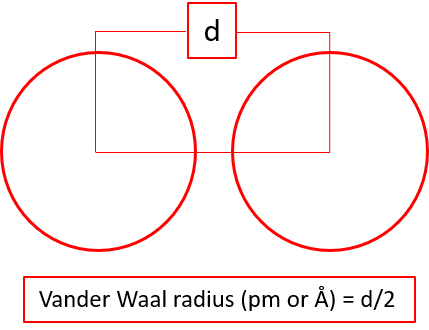
Covalent radius
Half the distance between the nuclei of two identical atoms bonded covalently. Used for non-metals. For diatomic molecules like Cl₂, the covalent radius is half the bond length.
Metallic radius
Half the distance between the nuclei of two adjacent atoms in a metallic crystal lattice. Used for metals — copper, iron, silver, gold.
Van der Waals radius
Half the distance between the nuclei of two non-bonded atoms in adjacent molecules. Used for noble gases and other situations where atoms are in contact but not bonded.
The atomic radius finds important applications in materials science:
Interstitial compounds
Transition metal borides, nitrides, and carbides — the ratio of the small atom’s radius to that of the transition metal predicts stability of these interstitial compounds.
Ultra-high-temperature ceramics
Transition metal borides survive 1700°C — used on hypersonic vehicles and re-entering spacecraft. A hypersonic vehicle can travel four times the speed of sound and helps launch satellites at low cost.
Cutting-tool coatings
Transition metal carbides are hard coatings that protect cutting tools from wear and erosion, extending their service life dramatically.
Trends Across the Table
Groupwise Analysis
Trend Analysis
Loading…- Beatriz Cordero et al., Covalent radii revisited. Dalton Transactions, 2008, doi:10.1039/b801115j
- William M. Haynes, CRC Handbook of Chemistry and Physics, 95th ed., CRC Press, 2014
- Kaye & Laby tables of physical & chemical constants (2017)
- Royal Society of Chemistry — interactive periodic table
Periodwise Analysis
Trend Analysis
Loading…- Cordero et al., 2008
- CRC Handbook of Chemistry and Physics, 95th ed.
Transition Metals Analysis
Trend Analysis
Loading…- CRC Handbook of Chemistry and Physics, 95th ed.
Lanthanide / Actinide Analysis
Trend Analysis
Loading…- Cordero et al., 2008